Full access from CA$39 for 30 days, one payment, nothing renews, and a full refund within 14 days. Communication is free to every account.
See CPTE pricingStudy plan
A study plan for your date.
The CPTE’s course week by week to your exam date, with the hours it takes.
By email, with no account needed.

Everything the CPTE tests, in one place
70
Lessons
2,475
Practice questions
2,687
Flashcards
Full length
Timed mock exams
Blueprint
What the CPTE covers.
Graduates of Canada’s accredited physiotherapy programs, and internationally educated physiotherapists with a CAPR credentialling decision, seeking registration as a physiotherapist anywhere in Canada except Quebec.
CAPR publishes the blueprint below. The percentages are the share of the Written Section each area accounts for — not separate hurdles, since the section is scored on the total number of questions answered correctly, and the result combines it with the Oral Section. Every lesson sits under its area and reads in the app.
Assessment and Diagnosis
21 lessons
30%of the Written Section
- The interview and other sources of information
- Tests and measures, their interpretation and the ICF
- Physiotherapy diagnosis, indication, prognosis and reassessment
- Assessing muscle, fascia and tendon disorders
- Assessing ligament and joint injuries
- Assessing bone injuries and fractures
- Assessing the cervical spine: neck pain, headache and whiplash
- Assessing the thoracic and lumbar spine
- Assessing degenerative and rheumatic conditions
- Assessing chronic pain, pelvic floor and inflammatory conditions
- Assessing amputations and congenital malformations
- Assessing brain injury, stroke and cerebellar disorders
- Assessing spinal cord injury and peripheral nerve disorders
- Assessing degenerative, demyelinating and developmental neurological disorders
- Assessing cognitive, mental health, seizure, vestibular and infectious neurological conditions
- Assessing cardiac and vascular disorders
- Assessing obstructive, restrictive and parenchymal respiratory conditions
- Assessing congenital, environmental and infectious respiratory conditions
- Assessing integumentary, metabolic, reproductive and gastrointestinal conditions
- Assessing immune disorders, infections and oncology
- Assessing complex conditions and healthy populations
Care Planning
21 lessons
30%of the Written Section
- Informing and involving the client, and setting goals
- The intervention plan
- Self-management, modifying the plan, discharge and transition
- Managing muscle, fascia and tendon disorders
- Managing ligament and joint injuries
- Managing bone injuries and fractures
- Managing the cervical spine: neck pain, headache and whiplash
- Managing the thoracic and lumbar spine
- Managing degenerative and rheumatic conditions
- Managing chronic pain, pelvic floor and inflammatory conditions
- Managing amputations and congenital malformations
- Managing brain injury, stroke and cerebellar disorders
- Managing spinal cord injury and peripheral nerve disorders
- Managing degenerative, demyelinating and developmental neurological disorders
- Managing cognitive, mental health, seizure, vestibular and infectious neurological conditions
- Managing cardiac and vascular disorders
- Managing obstructive, restrictive and parenchymal respiratory conditions
- Managing congenital, environmental and infectious respiratory conditions
- Managing integumentary, metabolic, reproductive and gastrointestinal conditions
- Managing immune disorders, infections and oncology
- Managing complex conditions and healthy populations
Client Safety and Client-Centred Care
9 lessons
13%of the Written Section
- Respecting uniqueness, diversity and autonomy
- Safe and comfortable assessment and intervention
- Monitoring the client during a session and across care
- Precautions, contraindications and risks: musculoskeletal and neurological
- Precautions, contraindications and risks: cardiorespiratory and medical
- Urgent conditions that need immediate action
- Infection control
- Near misses and adverse events
- Advocating for access to care
Professional Responsibilities
6 lessons
7%of the Written Section
- Regulation, the Model Standards and the Code of Ethical Conduct
- Informed consent
- Confidentiality and privacy
- Conflicts of interest and professional boundaries
- Evidence-informed practice, critical appraisal and learning needs
- Scope of practice, competence, wellbeing and the social determinants of health
Collaboration
5 lessons
10%of the Written Section
- Collaborative care and sharing information with the team
- Shared roles and conflict in the team
- The learning needs of others and educating peers
- Orienting, training and assessing personnel
- Assigning care to personnel, guidance and feedback
Communication
4 lessons · free to every account
5%of the Written Section
- Rapport, trust and active listening
- Body language and difficult conversations
- Adapting communication to purpose, setting and understanding
- Health records and electronic technologies
Practice Management
4 lessons
5%of the Written Section
- Business practices and outcome data
- Resources, waitlists, caseloads and employer expectations
- Records: accuracy, confidentiality, retention and destruction
- Workplace risks and hazards
Communication is free in full with a free account.
Practice
Practice in the app.
Every question cites the document it came from, and a free account opens Communication in full.
- 2,475 questions in the exam’s format, written to the blueprint across its 7 content areas
- 1,976 in vignettes, as the exam sets them
- A rationale and the document it comes from, for every answer
- A timed mock in the Written Section’s format: 100 questions in 150 minutes
- Communication free in full with a free account: 114 questions with your progress kept, plus the diagnostic and your study plan
See what the questions look like
Create a free accountInside the app
Everything the exam tests, and nothing it does not.
No videos to sit through and no cohort to keep up with: just the practice and the feedback the exam rewards. This is what it looks like.
Lessons mapped to the blueprint.
Always know what a lesson is worth
- Each lesson sits under one content area of the published blueprint
- Every lesson names its area’s weight in the blueprint
- Every lesson lists its key takeaways
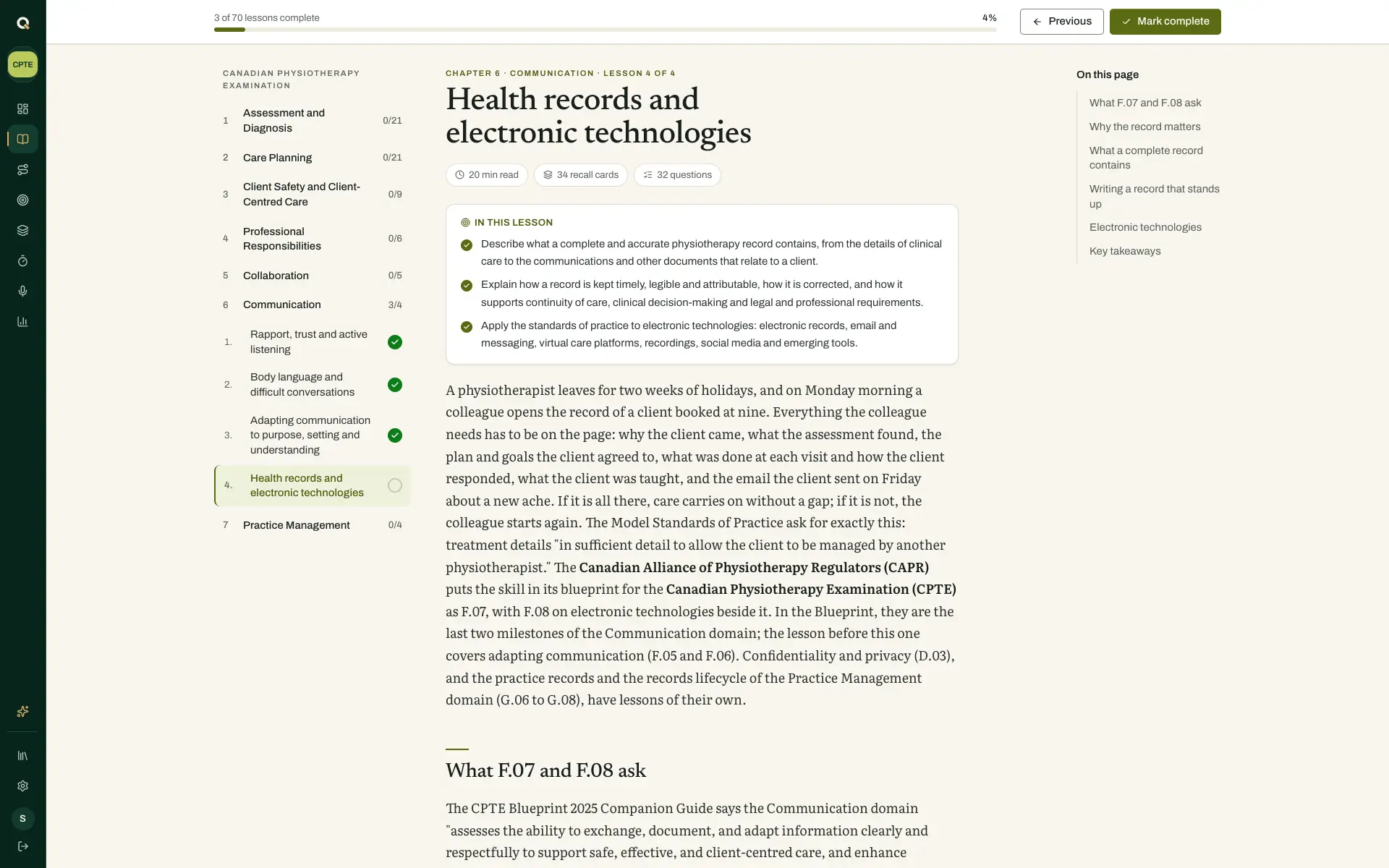
Flashcards for the terms and figures.
Turn repetition into recall
- The terms and figures of each lesson, one card at a time
- In the app, spaced repetition brings a card back just before you would forget it
- Every card shows where its answer comes from
A plan, mock exams, and readiness you can read.
Paced to your exam date
- A plan from your exam date that re-ranks as you answer
- Timed mock exams with the exam’s own question count and time limit
- Readiness is each area’s weight times your accuracy in it, summed
Progress
CPTE · exam in 9 weeks
Readiness
By area
- Assessment and Diagnosis82%
- Care Planning74%
- Client Safety and Client-Centred Care61%
- Professional Responsibilities48%
- Collaboration69%
- Communication77%
+1 more
Weakest area
Professional Responsibilities — 7% of the Written Section. Review its lessons, then a set of questions.
Mock exams
+13 since the last mock
Format
Format and logistics.
Taken from CAPR’s published documents, pinned by hash so a revised edition shows up as a change.
- Sections
- The Oral Section comes first: 10 structured cases of 15 minutes each, answered aloud to two examiners, scored out of 150 and worth 60% of the result. The Written Section follows a break of about an hour: 100 multiple-choice questions, 80 of them in cases of four and 20 standing alone, scored out of 100 and worth 40%.
- Questions, Written Section
- 100
- Duration
- 300 minutes in all; the Written Section is 150 minutes
- Delivery
- Virtual, remotely proctored; no test centres
- Passing score
- One pass or fail result covers both sections. No numeric passing score is published: each section has its own criterion-referenced standard, and the two are combined 60/40.
- Open book
- No
- Retakes
- Three attempts in all for a candidate whose first CAPR exam attempt was on or after January 1, 2013, and five for earlier candidates. Failed attempts at the PCE Clinical Component and at provincial clinical exams count. There is no time limit for using them.
- Fees
- CA$2,500
- Jurisdiction
- Canada
How the Oral Section runs
- Each case gives a client profile and a clinical scenario, then three questions, which you answer aloud, in order, within 15 minutes.
- One question comes from Assessment and Diagnosis or Care Planning, one from Client Safety and Client-Centred Care, and one from Professional Responsibilities, Collaboration, Communication or Practice Management.
- Two examiners mark each question against a checklist of acceptable points and a 4-point performance scale; their scores are combined and averaged for each case.
- QualExam’s practice cases run the same way: 15 minutes, three questions answered aloud, then you mark yourself against each question’s checklist and a 4-point scale. No one hears or scores your answers. CAPR’s free CPTE Tutorial includes an example case to practise on.
Questions
CPTE questions, answered.
Each answer names the document it comes from.

What is the CPTE, and who takes it?
The Canadian Physiotherapy Examination is the entry-to-practice exam that CAPR runs from 2026, combining the two parts of the former Physiotherapy Competency Examination into one. The Canadian physiotherapy regulators, except Quebec’s, have agreed in principle to use it as their licensure exam. Graduates of accredited Canadian programs take it once they have finished their program; internationally educated physiotherapists take it after a successful CAPR credentialling assessment.
Source: CAPR: Important Transition Information; CAPR: Examination Eligibility Policy
How is the CPTE structured?
Two sections on one day, taken online with remote proctoring: the Oral Section first, 2.5 hours for 10 structured cases, then, after a break of about an hour, the Written Section, 2.5 hours for 100 multiple-choice questions.
Source: CPTE Candidate Guide (November 2025), pages 4 and 9
How much does each section count?
The Oral Section is scored out of 150 and counts for 60% of the result; the Written Section is scored out of 100 and counts for 40%. Within the Written Section, Assessment and Diagnosis and Care Planning are 30% each, Client Safety and Client-Centred Care 13%, Collaboration 10%, Professional Responsibilities 7%, and Communication and Practice Management 5% each.
Source: CPTE Candidate Guide (November 2025), page 16; CPTE Blueprint 2025, Table 2
What kinds of questions are on the Written Section?
Multiple-choice questions with one correct option of four. From 75% to 80% are presented fully in writing; the other 20% to 25% add an image, a video or audio to the written content. A wrong answer costs nothing, so answer every question.
Source: CPTE Blueprint 2025, Table 1; CPTE Candidate Guide (November 2025), pages 10 and 15
What is a vignette?
A short description of a client and their situation, followed by four questions about it. The first 80 questions of the Written Section come in 20 vignettes of four; the last 20 stand alone. Qualifiers such as BEST, MOST and FIRST are written in capitals and bold.
Source: CPTE Candidate Guide (November 2025), pages 10, 11 and 14
What is the passing score?
CAPR publishes no numeric passing score. Each section has its own criterion-referenced standard, and the two section scores are combined 60/40 into one pass or fail result. There is no automatic fail for a wrong answer to a safety or professionalism question, and no minimum number of cases to pass.
Source: CPTE Candidate Guide (November 2025), page 16
When do results come out?
CAPR sends results about four to five weeks after the exam, with feedback on your performance whether you pass or fail.
Source: CAPR: CPTE Frequently Asked Questions
How many attempts do I get?
Three if your first PCE Written Component attempt was in 2013 or later, or if the CPTE is your first CAPR exam; five if your first PCE Written attempt was before 2013. Unsuccessful attempts at the PCE Clinical Component or a provincial clinical exam count toward the limit; PCE Written attempts do not, unless you have used them all. There is no time limit for using your attempts, and a new attempt means both sections again.
Source: CAPR: Examination Eligibility Policy; CAPR: CPTE Frequently Asked Questions
How much does the CPTE cost, and what if I reschedule or withdraw?
CA$2,500 an attempt. The CA$1,800 rate for candidates who passed the PCE Written Component in 2025 covered 2026 sittings only, and their application deadlines have passed. Rescheduling costs CA$250 before your sitting’s application deadline, CA$1,250 after it, and the full fee within 48 hours of the exam. Withdrawing before the deadline refunds 90% of the fee and after it 50%, until 48 hours before the exam; after that, and for a no-show or an arrival more than 15 minutes late, nothing is refunded.
Source: CAPR: CPTE Dates and Fees (web page, read 2026-10-27)
When is the CPTE offered, and when do applications close?
CAPR runs several sittings a year, six of them scheduled for 2027, and each has an overflow date in case candidate numbers exceed examiner or proctor availability, so keep both dates open. Applications close about ten weeks before each sitting, by 11:59 Eastern Time on the deadline, through CAPR’s Client Portal. The dates are on CAPR’s Dates and Fees page.
Source: CAPR: CPTE Dates and Fees (web page, read 2026-10-27)
I trained outside Canada. Can I take the CPTE?
Yes, once CAPR’s Credentialling Program has confirmed your eligibility in writing. You must attempt the CPTE within two years of a successful credentialling decision, and work experience does not replace either step. You can sit the exam from outside Canada; CAPR assigns appointments at reasonable local times as far as the Canadian time zones allow.
Source: CAPR: Examination Eligibility Policy; CAPR: CPTE Frequently Asked Questions
Do physiotherapists in Quebec take the CPTE?
No. The Canadian physiotherapy regulators, with the exception of Quebec’s, have agreed in principle to use the CPTE as their licensure exam.
Source: CAPR: Important Transition Information
Does CAPR offer a practice test or a tutorial?
Yes. CAPR’s free CPTE Tutorial walks through both sections on the exam platform, with an example oral case; it opens at demo.capr.assess.risr.global with the login CAPR publishes (username Candidate, password Thisisademo). CAPR also sells a Written Component practice exam of 200 retired PCE questions for CA$120, which returns a score report but not the questions or the answers.
Source: CAPR: CPTE Practice Tools (web page, read 2026-10-06)
What does QualExam offer for the CPTE, and what doesn’t it?
Lessons mapped to CAPR’s blueprint, original practice questions in its vignette format, flashcards, a timed mock of the Written Section, and practice cases for the Oral Section. Every question and case is written here; none is CPTE content. The questions are text only: where CAPR’s exam shows an image, a video or a sound, ours describe the finding in words, and CAPR’s free tutorial shows how its media questions work. The cases run as the Oral Section’s do, 15 minutes for three questions answered aloud, and then you mark yourself against each question’s checklist and scale: no one hears or scores your answers, as two examiners do in the exam.
Source: CPTE Blueprint 2025, Table 1; CPTE Candidate Guide (November 2025), pages 6, 7, 10 and 16
Is the course in French?
No. CAPR publishes its CPTE information in English and French; QualExam’s CPTE lessons, questions and mock exam are in English only.
Source: CAPR: The Canadian Physiotherapy Examination, Getting Started (web page, read 2026-10-06), and its French version
Articles
Latest articles.
- Oct 19, 2026
The cost of becoming a physiotherapist in Canada
What it costs to become a physiotherapist in Canada in 2026 and 2027: CAPR's credentialling fees, the CPTE at CA$2,500, the course, tests and a licence.
Read the article - Oct 19, 2026
Moving to Canada as a UK, US or Australian physio
CAPR's Pre-Approved Pathway for physios from the UK, US, Australia, Ireland, New Zealand, Hong Kong or South Africa: who qualifies, the fee and the CPTE.
Read the article - Oct 15, 2026
CPTE ethics questions: how to answer them
How the CPTE tests ethics: where it sits, the two CAPR documents behind the answers, a method for the best option, and the situations it returns to.
Read the article
Sources
Where this comes from.
Every figure above is taken from the documents below, pinned by hash so a revised edition shows up as a change. Where CAPR’s own sources disagree with each other, the controlled document wins and the disagreement is recorded.
- CPTE Blueprint 2025Blueprint 2025, which the CAPR Board adopted in December 2024; PDF of January 23, 2026
- CPTE Blueprint 2025 Companion GuideVersion 1.1, September 2026
The Canadian Physiotherapy Examination (CPTE) is developed and administered by the Canadian Alliance of Physiotherapy Regulators (CAPR), which states that it "does not approve, endorse, and recommend any resource that we do not create ourselves." QualExam is an independent study resource and is not affiliated with, endorsed by, or sponsored by CAPR or any physiotherapy regulator. Every question here is original; none is CPTE content.
By QualExam editorial. Written against the certifying body’s published documents, pinned by hash so a revised edition shows up as a change.
Source: CPTE Blueprint 2025
Last checked against the source: October 6, 2026
A full refund within 14 days.
No reason needed.
If paid access is not working for you, write to us within 14 days of the payment and we refund it in full, to the way you paid.